

Does Golf Hypnosis Work? A Realistic 2026 Guide for Golfers
Can hypnosis really help you play better golf?
If you’ve ever struggled with first-tee nerves, lost confidence in your putting, or found yourself overthinking your swing, you may have wondered whether golf hypnosis could help.
There are recordings and practitioners promising everything from greater confidence to freedom from the yips. But how much of this is supported by evidence, and what can hypnosis realistically do for your game?
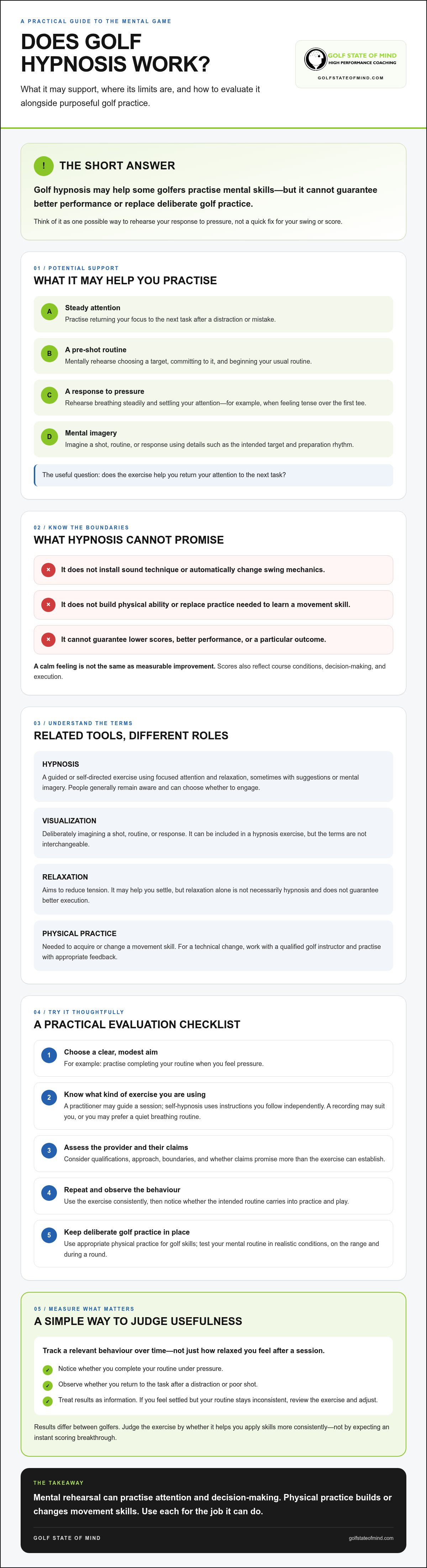
The short answer is that hypnosis may help some golfers with relaxation, mental rehearsal, and aspects of attention, but there is limited high-quality research demonstrating that hypnosis itself improves golf performance.
I’m David MacKenzie, a golf mental performance coach and founder of Golf State of Mind. In my coaching, I focus on helping golfers develop practical mental skills they can use during practice and competition.
In this article, I’ll explain what golf hypnosis involves, where it might be useful, what it cannot reliably do, and several alternatives you can begin practising immediately.
What Is Golf Hypnosis?
Golf hypnosis is the application of hypnotic techniques to golf-related performance goals.
A typical session might involve guided relaxation, focused attention, mental imagery, and suggestions intended to support confidence or a particular performance response.
For example, a recording might guide you through imagining yourself standing on the first tee, breathing comfortably, choosing a target, and making a committed swing.
Other recordings may focus on putting confidence, dealing with pressure, or responding to mistakes.
Hypnosis is not the same as being unconscious or surrendering control of your mind. It generally involves focused attention and responsiveness to suggestions, and individual experiences vary.
It’s also important to distinguish hypnosis from other mental training methods.
- Hypnosis: A process involving focused attention and suggestion, sometimes accompanied by relaxation or imagery.
- Visualization: Deliberately imagining a shot, situation, or performance response.
- Meditation: A range of practices involving attention, awareness, or observation of experience.
- Mental performance coaching: Developing skills such as routines, decision-making, attention, confidence, and responses to pressure.
These approaches can overlap, but they aren’t interchangeable.
Does Golf Hypnosis Actually Work?
The answer depends on what you mean by “work.”
If you mean whether a hypnosis recording might help you feel more relaxed or mentally prepared before a round, some golfers may find it useful.
If you mean whether hypnosis has been conclusively shown to lower golf scores, cure the yips, or permanently eliminate performance anxiety, the evidence does not justify those promises.
Research into hypnosis has explored its use in several psychological and clinical contexts, but evidence from those settings shouldn’t automatically be applied to competitive golf.
Golf-specific outcomes are particularly difficult to assess because scores depend on so many factors: technical skill, course conditions, decision-making, physical preparation, and the quality of execution.
A golfer who plays well after listening to a hypnosis recording may have benefited from the experience. But one good round doesn’t establish that hypnosis caused the improvement.
My view is that hypnosis is best considered a possible supplementary mental preparation method, rather than a shortcut to better performance.
Five Areas Where Golf Hypnosis Might Help
1. Managing Pre-Round Nerves
Some golfers become particularly anxious before an important tournament, a club championship, or a round where they expect to play well.
A guided relaxation or hypnosis exercise may help them settle before arriving at the course.
However, I wouldn’t make feeling calm a requirement for playing well.
Nerves are a normal part of competition. Even accomplished golfers experience them.
A more useful objective is to develop the ability to make good decisions and follow your routine while nerves are present.
That’s a skill you can practise independently of hypnosis.
2. Rehearsing a Pre-Shot Routine
One practical use of guided imagery is mentally rehearsing your pre-shot routine.
Imagine approaching the ball, assessing the situation, choosing a target, and committing to the shot.
Then imagine stepping into the shot and allowing your athletic skills to take over.
In my coaching, I teach three phases:
- Planning Phase: Assess the shot, make a decision, and commit to your plan.
- Athletic Phase: Shift from analysis to execution and respond to the target.
- Acceptance Phase: Accept the outcome and move forward.
You can rehearse this sequence in a guided recording, through ordinary visualization, or simply by practising it on the range.
Learn more in my guide to developing a mental pre-shot routine for golf.
3. Developing More Constructive Self-Talk
Golfers sometimes develop patterns of self-talk that make difficult situations feel even more threatening.
For example:
- “I always choke when I’m playing well.”
- “I can’t hit my driver under pressure.”
- “I know I’m going to miss this putt.”
A hypnosis recording may include suggestions intended to encourage a more constructive mindset.
But changing your self-talk doesn’t require hypnosis.
You can begin by noticing the stories you tell yourself and replacing unhelpful judgments with instructions that support the next action.
Instead of “I can’t hit my driver under pressure,” you might say:
“Choose the target. Commit to the shot.”
That’s not an attempt to convince yourself that everything will go perfectly. It’s a reminder of what you can control.
4. Mental Rehearsal and Visualization
Many golf hypnosis recordings incorporate visualization.
You might imagine hitting a confident tee shot, making a smooth putting stroke, or responding constructively after a mistake.
Imagery can be useful for rehearsing decisions, routines, and performance situations.
However, it’s important to avoid treating mental rehearsal as a replacement for physical practice.
Imagining a technically sound swing doesn’t automatically give you the movement skills required to produce it.
And visualization doesn’t have to involve imagining only perfect outcomes.
One exercise I use is to imagine a challenging situation and rehearse how you’ll respond.
For example, picture yourself missing a short putt during a tournament.
Rather than imagining that you’ll never miss, rehearse accepting the result, maintaining your body language, and preparing properly for the next shot.
That develops a more realistic form of mental preparation.
5. Supporting Confidence
Some golfers use hypnosis because they want to feel more confident.
And while guided suggestions may influence how someone feels, I think there’s a more important distinction to understand:
Confidence isn’t only a feeling. It’s also reflected in how you behave.
A golfer who feels nervous but makes a clear decision, commits to the target, and follows their routine is displaying confident behavior.
Waiting until you feel completely confident before committing to a shot can become a trap.
Instead, practise the behaviors you associate with confident golf, even when doubt is present.
Build Confidence You Can Use on the Course
Download my free mental game ebook for practical strategies to improve your routines, manage pressure, and respond more effectively to mistakes.
Can Golf Hypnosis Help With the Yips?
The yips are one of the reasons golfers become interested in hypnosis.
When a golfer experiences an involuntary movement, hesitation, or sudden loss of control during putting, chipping, or driving, it’s understandable that they might look for a mental solution.
But the yips are complex.
Different golfers can experience similar symptoms for different reasons. Anxiety and excessive conscious control may contribute in some cases, while movement-related factors can also be involved.
For that reason, I would be cautious about anyone claiming that hypnosis can reliably cure the yips.
A guided recording might help a golfer with relaxation or mental rehearsal, but that doesn’t establish that it addresses the underlying cause of their symptoms.
For persistent yips, it’s worth seeking appropriate professional assessment, particularly when involuntary movements are involved.
From a mental performance perspective, I often focus on helping golfers reduce excessive attention to mechanics during execution, develop a more functional routine, and rebuild trust through appropriately structured practice.
You can explore related principles in my guide to overcoming mental blocks on the golf course.
Golf Hypnosis vs. Visualization: What’s the Difference?
Visualization is frequently included in hypnosis recordings, but you don’t need hypnosis to benefit from mental rehearsal.
For example, before a round, you can spend three minutes imagining yourself playing the first hole.
Picture the tee, your target, and the kind of swing you intend to make.
Then imagine a less-than-perfect outcome, such as finding the rough.
See yourself responding constructively: assessing the next shot, choosing a sensible target, and committing to your decision.
This is a practical form of mental rehearsal because you’re preparing for the reality of golf, not just imagining an uninterrupted series of perfect shots.
The distinction matters.
Some golfers become so focused on achieving the perfect mental state that they begin monitoring their thoughts and emotions throughout the round.
That can distract them from the actual task of playing golf.
As I explain in my article on getting into the flow state in golf, the objective isn’t to force yourself into a particular state of mind. It’s to become more fully involved in the game.
A Five-Minute Mental Rehearsal Exercise You Can Try
If you’re curious about the potential benefits of golf hypnosis, you can first experiment with a straightforward visualization exercise.
This isn’t hypnosis or hypnotherapy. It’s a practical mental rehearsal exercise designed to help you prepare for situations you’ll encounter on the course.
Minute 1: Settle Your Attention
Sit somewhere quiet and comfortable.
Take a few slow, comfortable breaths and allow your attention to settle.
You don’t need to empty your mind or eliminate every thought.
Simply notice your breathing and bring your attention back whenever it wanders.
Minute 2: Rehearse Your First Tee Shot
Imagine standing on the first tee.
Notice the surroundings, the target, and the shot you want to play.
Mentally rehearse your Planning Phase: assess the situation, choose the shot, and commit to your decision.
Minute 3: Rehearse Athletic Execution
Imagine stepping into the shot with a clear intention.
Rather than thinking through several technical swing positions, direct your attention toward the target and the rhythm of your movement.
Picture yourself following your normal routine.
Minute 4: Rehearse a Difficult Moment
Now imagine that something doesn’t go according to plan.
Perhaps you hit a poor drive, miss a short putt, or make a double bogey.
Notice the frustration that might follow.
Then imagine responding as the player you want to be: acknowledging the result, maintaining constructive body language, and preparing properly for the next shot.
Minute 5: Choose Your Performance Commitments
Finish by choosing two or three behaviors you want to commit to during your round.
For example:
- I will make a clear decision before every shot.
- I will commit fully to the shot I’ve chosen.
- I will accept each result and prepare properly for the next shot.
These commitments give you something practical to measure after the round, regardless of your score.
Remember the Golf State of Mind principle:
Plan the shot. Play the shot. Accept the shot.
How to Evaluate a Golf Hypnosis Recording or Practitioner
If you’d still like to explore golf hypnosis, choose your resources carefully.
Not all recordings and practitioners have the same qualifications, methods, or standards.
Here are some useful questions to ask:
- What is the goal? Is the exercise intended to support relaxation, mental rehearsal, or another specific skill?
- Who created it? Does the practitioner have relevant training, and are their qualifications clearly explained?
- What claims are being made? Be skeptical of promises to cure the yips, eliminate nerves permanently, or guarantee lower scores.
- Is the approach comfortable for you? You should understand what the exercise involves and be free to stop if it feels uncomfortable.
- How will you assess progress? Look for changes in useful behaviors rather than relying entirely on how relaxed you feel immediately afterward.
It’s also worth distinguishing performance coaching from clinical treatment. If you’re seeking help with a mental health condition, look for an appropriately qualified healthcare professional.
What I Recommend Instead of Relying on Hypnosis Alone
Over years of coaching golfers, I’ve found that the most useful mental training is often straightforward.
It isn’t necessarily about achieving a special state of consciousness or eliminating negative thoughts.
It’s about developing repeatable behaviors that support your performance.
Here are four areas I’d prioritize.
1. A Reliable Pre-Shot Routine
Learn to separate planning from execution.
Make a clear decision, commit to it, and allow yourself to play the shot without continuing to analyze the swing.
2. Acceptance of Uncertainty
Golf is unpredictable.
Even when you make a good decision and execute with commitment, the outcome won’t always be what you want.
Acceptance allows you to remain engaged in the process without demanding a particular result.
3. Constructive Responses to Mistakes
Don’t measure your mental game by whether you ever get frustrated.
Measure it by how you respond when frustration appears.
Can you make a sensible decision on the next shot? Can you follow your routine? Can you remain committed?
4. Practice Under Realistic Pressure
Mental rehearsal is useful, but your skills also need to be tested on the course.
Use one-ball practice, scoring games, consequences, and competitive situations to practise your routines when outcomes matter.
For more on applying these skills during a round, read my guide to golf mental strategy and on-course composure.
Frequently Asked Questions About Golf Hypnosis
Does golf hypnosis really work?
Golf hypnosis may help some golfers with relaxation, focused attention, or mental rehearsal. However, there is limited high-quality golf-specific evidence demonstrating that hypnosis reliably improves scores. Its effects can vary considerably between individuals.
Can hypnosis improve golf confidence?
Some golfers may find guided suggestions or mental imagery helpful for their subjective confidence. However, confidence also develops through preparation, experience, and committed behavior on the course. Hypnosis isn’t required to practise those skills.
Can hypnosis cure the golf yips?
There isn’t sufficient evidence to describe hypnosis as a reliable cure for the yips. Because the yips can involve different contributing factors, persistent symptoms deserve appropriate assessment rather than reliance on a single mental technique.
Is golf hypnosis the same as visualization?
No. Visualization involves deliberately imagining a shot, routine, or performance situation. Hypnosis may incorporate visualization alongside focused attention and suggestion, but the two methods are not identical.
Can I practise golf self-hypnosis?
Some golfers use guided self-hypnosis recordings independently. If you choose to try one, use a reputable source, understand the exercise, and avoid practising while driving or doing anything that requires your full attention. Stop if the experience feels uncomfortable.
How long does golf hypnosis take to work?
There is no established timeline that applies to every golfer. A particular number of sessions cannot guarantee an improvement. If you try hypnosis, assess whether it helps you perform a specific useful behavior consistently during practice and play.
Can hypnosis help me stop overthinking my golf swing?
A guided exercise may help some golfers redirect attention, but overthinking can also be addressed through a clear pre-shot routine, an appropriate external focus, and practice that separates technical learning from athletic execution.
Should I try golf hypnosis or mental performance coaching?
That depends on your goals. Hypnosis may appeal if you’re interested in guided suggestion or relaxation. Mental performance coaching generally focuses more broadly on routines, decision-making, attention, confidence, and responding to pressure. The approaches are different, and neither guarantees a particular score.
Final Thoughts: Does Golf Hypnosis Work?
Golf hypnosis may be useful for some players as a form of guided mental preparation, particularly when it incorporates relaxation, imagery, or rehearsal of helpful behaviors.
But it isn’t a proven shortcut to lower scores, and it shouldn’t be treated as a guaranteed solution to nerves, overthinking, or the yips.
Whatever method you choose, the real test is whether it helps you perform more effectively on the course.
Can you make clear decisions? Follow your routine? Commit to your shots? Accept the results and move on?
Those are skills worth developing, whether you use hypnosis or not.
You don’t need a perfect mental state to play good golf. You need a process you can trust.
Take Your Mental Game to the Next Level
If you want practical mental training strategies you can use before, during, and after your rounds, download my free mental game ebook.
Get your FREE Mental Game Scorecard
