
Mastering First Tee Nerves: How to Stay Calm and Confident from Shot One
You’re standing on the first tee.
Your name has been announced, or your playing partners are waiting behind you.
Maybe the starter is watching.
Your heart is beating faster.
Your hands feel different.
And the swing that felt completely natural on the practice range suddenly doesn’t feel quite as automatic.
First tee nerves in golf are completely normal.
In fact, one of the biggest mistakes golfers make is believing they shouldn’t feel nervous.
They think:
“I need to calm down.”
“Why am I nervous?”
“I was hitting it perfectly on the range.”
Now they’re not only preparing for the opening shot.
They’re also trying to fix how they feel.
There’s a better approach.
You don’t need to eliminate your nerves before you hit the first shot.
You need to accept the energy that’s there, regulate it if necessary, narrow your attention to the task and make a committed swing.
You can be nervous and still play good golf.
Key Takeaways
- First tee nerves are a normal response when the round matters to you.
- You don’t need to feel completely calm or confident before you can hit a good opening shot.
- Trying to eliminate nerves can actually give them more of your attention.
- Use slower breathing to regulate your level of arousal rather than trying to force yourself to relax.
- Don’t use your range warm-up to predict how you’re going to play.
- Narrow your attention from the entire round to the specific shot in front of you.
- Choose a clear target and make a committed decision.
- Use your normal pre-shot routine rather than creating a special “nervous” routine.
- Practice first-tee situations so competition isn’t the only place you experience consequence.
- Whatever happens on the opening shot, it doesn’t define the rest of your round.
Why Do Golfers Get First Tee Nerves?
The opening shot of a round is unusual.
You’ve been warming up.
Perhaps hitting ball after ball.
Then suddenly you have one ball.
One shot.
And it counts.
There may also be people watching.
That creates consequence and uncertainty — two things that naturally increase pressure.
The First Shot Can Feel Bigger Than It Is
The first tee can start to feel like a test.
“Am I going to have it today?”
“What if I hit it out of bounds?”
“What will these people think if I hit a terrible shot?”
“What if my swing doesn’t feel like it did on the range?”
You’re no longer simply trying to hit a golf shot.
You’re trying to answer questions about the next four hours.
Fear of Judgment Makes It Worse
Golfers often become more self-conscious when other people are watching.
You may become aware of:
- How your swing looks.
- Whether you’re taking too long.
- What your playing partners think of your game.
- Whether you’re going to embarrass yourself.
That moves your attention away from the task you’re actually trying to perform.
Your Nerves Aren’t the Problem
This is perhaps the most important idea in the article.
You do not need to get rid of first tee nerves.
You need to become better at playing while they’re present.
Stop Asking Whether You’re Calm Enough
If your goal is:
“I must feel calm before I hit.”
then you’re going to keep checking yourself.
“Is my heart still racing?”
“Are my hands still shaking?”
“Am I relaxed yet?”
All of that keeps your attention on the anxiety.
Try Acceptance Instead
You might simply acknowledge:
“I’m nervous because this matters to me.”
Or:
“There’s some energy here. That’s okay.”
Then return to your job.
You don’t need to love the feeling.
You just don’t need to fight it.
A Nervous Swing Can Still Be a Good Swing
Your hands might feel different.
Your heart might beat faster.
You might not have the same effortless feeling you had on the range.
None of those things automatically prevents you from hitting a good golf shot.
Want to feel more prepared when golf starts to matter? Download my free ebook, 7 Key Mental Strategies, for practical ways to improve confidence, focus and performance under pressure. Get the Free Ebook
Why the First Tee Feels Different From the Range
One reason first tee nerves in golf feel so strange is the contrast with the practice range.
Five minutes earlier you may have been hitting driver beautifully.
Then you reach the tee and suddenly everything feels different.
The Environment Changed
On the range:
- There’s another ball waiting.
- You can hit the same club repeatedly.
- You can immediately correct a poor shot.
- There’s usually little consequence.
On the first tee:
- You get one attempt.
- The shot counts.
- There may be trouble.
- People may be watching.
- You don’t know exactly what will happen.
It’s not surprising that the experience feels different.
Don’t Try to Recreate Your Range Swing
This is where golfers often get into trouble.
They stand over the ball searching for the feeling they had 15 minutes earlier.
“Why doesn’t it feel the same?”
Now they’re becoming increasingly internally focused.
You don’t need to recreate a particular feeling.
You need to play the shot that’s in front of you.
What to Do Before the Round
Your first tee preparation begins before you reach the tee box.
Don’t Make Your Warm-Up a Test
The purpose of your warm-up is to prepare.
Not to prove that you’re going to play well.
If you hit it beautifully:
Great.
But don’t create the expectation that every shot on the course must now look like that.
If you hit it poorly:
That’s okay too.
The warm-up isn’t the round.
Decide How You Want to Show Up
Before you play, choose one or two qualities you want to bring to the course.
For example:
- Committed.
- Patient.
- Brave.
- Present.
- Accepting.
This gives you something more useful to focus on than:
“I hope I don’t get nervous.”
Choose Your Process Goals
You might decide:
- Commit fully to every target.
- Use my routine.
- Accept every result.
These become your guidelines for the round.
Use Breathing to Regulate Your State
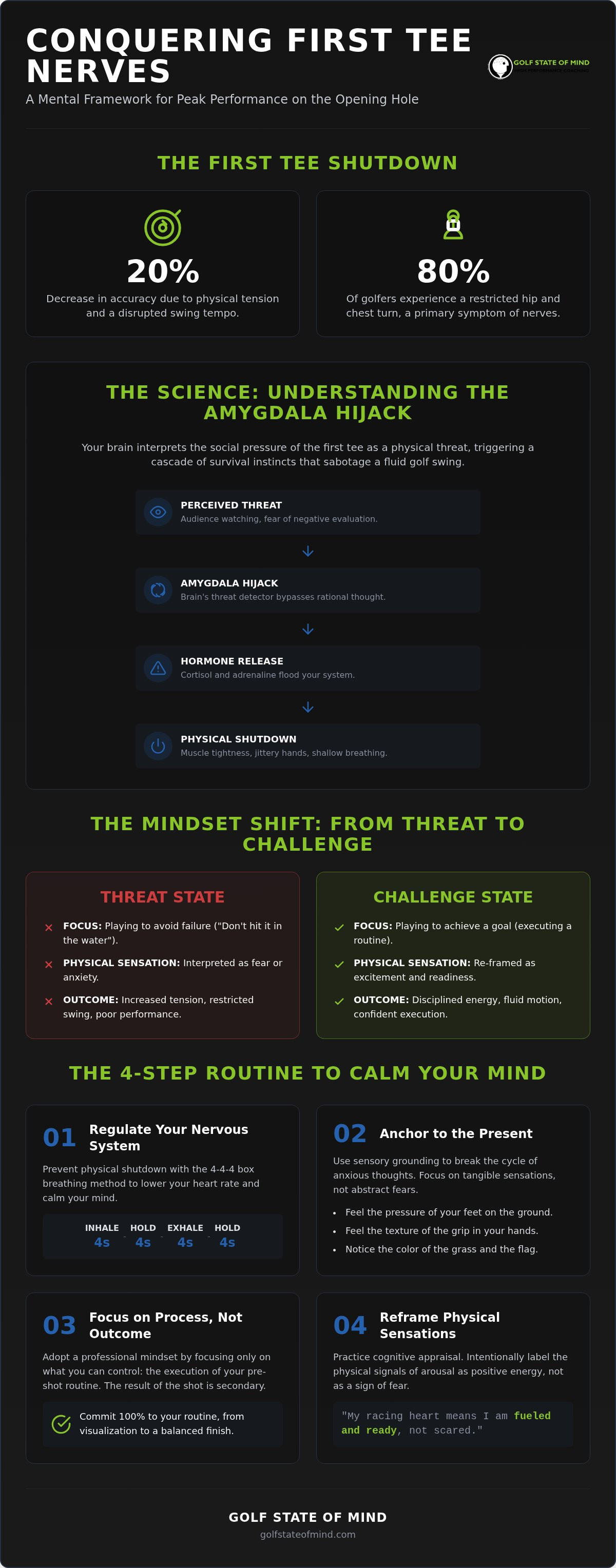
If you notice that your level of arousal is higher than you’d like, breathing can be a useful tool.
One technique I use with golfers is:
Inhale for 4 seconds. Exhale for 6 seconds.
Repeat for several breaths.
Why I Prefer a Longer Exhale
The purpose isn’t to knock yourself into a completely relaxed state.
You’re simply slowing things down and giving your attention something steady and controllable.
Don’t Judge Whether It Worked
You may take several breaths and still feel nervous.
That’s okay.
The breathing hasn’t failed.
Ask:
“Am I regulated enough to perform?”
That’s a much more useful standard than:
“Have all my nerves disappeared?”
What to Do While You’re Waiting to Tee Off
The waiting can sometimes be worse than the shot.
You have time to imagine every possible outcome.
Don’t Stare at the Tee Box
You don’t need to watch every player hit while mentally rehearsing your own disaster.
Allow your attention to stay broad.
Look around.
Talk to your playing partners.
Notice the course.
Use Your Senses
If your mind starts racing ahead, reconnect with the present.
You can use a simple grounding exercise such as:
- 5 things you can see.
- 4 things you can feel.
- 3 things you can hear.
- 2 things you can smell.
- 1 thing you can taste.
You don’t need to mechanically complete every step if you’re about to play.
The principle is simply to bring attention out of the imagined future and back into the environment you’re actually standing in.
Your First Tee Pre-Shot Routine
When it’s your turn to play, don’t invent a special first-tee routine.
Use the process you’ve practiced.
The Think Box
Behind the ball, gather the information you need.
Consider:
- The shape of the hole.
- Wind.
- Trouble.
- Club selection.
- Shot shape.
- Target.
Then make your decision.
The Play Box
Once you’ve made the decision, move from analysis toward execution.
See the shot.
Feel it.
Connect with your target.
Commit.
Play.
If You’re Not Committed, Step Away
If you’re standing over the ball thinking:
“Maybe I should hit 3-wood.”
or:
“I’m not sure about this target.”
step away.
Resolve the decision.
Then start again.
Move Your Attention Toward the Target
First tee anxiety tends to pull your attention toward everything you’re trying to avoid.
The water.
The trees.
Out of bounds.
The people watching.
The possibility of topping it.
Ask a Better Question
Instead of:
“How do I avoid hitting it right?”
ask:
“Where am I sending the ball?”
Make the Target Specific
Choose something you can actually see.
A tree.
A bunker edge.
A section of fairway.
A distant building.
Give your attention somewhere useful to go.
Commitment Is More Important Than Confidence
This is particularly important on the first tee.
You may not feel confident.
That’s okay.
Don’t Wait for Confidence
If you tell yourself:
“I’ll commit once I feel confident.”
you may be waiting a long time.
You can feel uncertain and still make a committed swing.
You Don’t Need Certainty About the Outcome
Commitment doesn’t mean believing the ball is definitely going down the middle.
You can’t know that.
Commitment means:
“This is my decision. This is my target. This is the shot I’m going to play.”
Then you give yourself permission to swing.
Confidence Can Follow Action
Sometimes golfers think confidence has to come first.
But often you build confidence by seeing yourself act decisively while you’re nervous.
That’s valuable evidence.
Should You Hit a Safer Club on the First Tee?
Not simply because you’re nervous.
Your club selection should be based on strategy.
Don’t Let Fear Make the Decision
If driver is clearly the best strategic choice, automatically reaching for an iron because you’re nervous can reinforce the idea that you can’t trust yourself under pressure.
But that doesn’t mean driver is always correct either.
Choose the Shot That Makes Sense
Consider:
- The width of the landing area.
- Where the trouble is.
- Your normal dispersion.
- The length of the hole.
- The next shot you’ll leave yourself.
Then make the best decision you can.
Once you’ve made it, commit.
What If You Hit a Terrible First Shot?
Let’s say you do everything well.
You breathe.
You choose a target.
You commit.
And then you hit it 60 yards right.
Now what?
Don’t Turn It Into a Prediction
The danger is immediately thinking:
“It’s going to be one of those days.”
Or:
“I knew I was too nervous.”
That’s a story.
The fact is:
You hit one poor golf shot.
Use Your Post-Shot Routine
Allow the reaction.
Take any useful information.
Accept where the ball finished.
Then begin switching your attention away from the shot.
The Second Shot Is a New Problem
When you reach the ball, ask:
“What does this shot require?”
Not:
“How do I undo what just happened?”
The first shot doesn’t get to hit the second one too.
Want a stronger process for handling nerves and pressure on the golf course? Download my free 7 Key Mental Strategies ebook for practical ways to improve confidence, focus, commitment and emotional control. Download the Free Ebook
Practice Your First Tee Nerves
If the only time you experience consequence is when you’re actually playing, you aren’t giving yourself many opportunities to practice this skill.
Finish Your Range Session With One Opening Drive
Instead of hitting your final ten balls with driver, try this:
Choose the first hole of the course you’re about to play.
Picture it.
Choose your club.
Choose your target.
Go through your complete routine.
Then hit one ball.
Don’t Hit Another One
This is the important part.
If you stripe it:
Great.
If you slice it:
Fine.
Don’t immediately pull another ball across to prove that you can hit a better one.
Accept it.
That’s much closer to what you’re about to experience on the course.
Create Pressure During Practice
You can also use consequence-based games.
Define a fairway between two targets.
Perhaps you need to hit four out of five drives into it.
Notice what happens when the final ball matters.
Do you speed up?
Become technical?
Try to steer it?
Start thinking about failure?
That’s your opportunity to practice your mental skills.
Your Simple First Tee Plan
You don’t need a complicated psychological system.
Keep it simple.
Before You Reach the Tee
- Accept that you may feel nervous.
- Use slower breathing if you need it.
- Keep your attention broad while you’re waiting.
When It’s Your Turn
- Assess the situation.
- Choose the club and shot.
- Select a clear target.
- Make the decision.
When You Step In
- See the shot.
- Feel the shot.
- Connect with the target.
- Commit.
- Play.
After the Shot
- Accept the outcome.
- Use your post-shot routine.
- Switch off.
- Start again at the next shot.
The Goal Isn’t to Feel Nothing
When golfers ask me how to overcome first tee nerves in golf, they often assume success means reaching the tee completely calm and confident.
I don’t think that’s the right goal.
If golf matters to you, there are going to be moments when you feel something.
That’s part of competition.
The goal is to become the golfer who can stand there with a faster heartbeat, some uncertainty and a little adrenaline — and still go through the process.
Choose the target.
See the shot.
Commit.
Swing.
And whatever happens:
Start again.
You don’t need to win the battle against your nerves before you hit the first shot.
You just need to play golf while they’re there.
Frequently Asked Questions
Is it normal to have first tee nerves in golf?
Yes. The first tee creates consequence, uncertainty and sometimes social evaluation, so feeling nervous is completely normal. The goal isn’t necessarily to eliminate those feelings but to become better at performing while they’re present.
How do I calm my nerves on the first tee?
Try accepting the nerves rather than fighting them. If your arousal feels too high, use slower breathing such as inhaling for four seconds and exhaling for six. Then redirect your attention toward the shot, target and routine rather than continuing to monitor how nervous you feel.
What breathing technique should I use for first tee nerves?
One simple option is to inhale for four seconds and exhale for six seconds for several breaths. The goal isn’t to eliminate every physical sensation but to regulate your state and give your attention something simple and controllable.
Why do I hit driver well on the range but badly on the first tee?
The environments are different. On the range you usually have another ball available and can hit the same club repeatedly. On the first tee you get one attempt with consequence attached to the result. This can change your attention, tension and level of conscious control.
What should I think about on the first tee?
Think about the information required to make the shot: conditions, club, shot selection and target. Once you’ve made the decision, shift away from analysis toward seeing the shot, feeling it, connecting with the target and committing.
Should I hit driver if I’m nervous on the first tee?
Choose the club based on the strategy of the hole rather than nerves alone. Consider the landing area, trouble, your normal dispersion and the next shot. Once you’ve made the decision, commit to it rather than continuing to debate the club over the ball.
How do I stop worrying about people watching me on the first tee?
You may not be able to prevent the thought from appearing. Instead, shift from self-consciousness to task-consciousness. Ask what the shot requires and direct your attention toward your target and routine rather than how you might look to other people.
What should I do if my hands shake on the first tee?
Acknowledge the physical sensation rather than treating it as proof that you can’t perform. Use slower breathing, soften unnecessary tension where you can and then return your attention to the target and shot. You don’t need perfectly steady hands to make a committed swing.
How do I recover if I hit a terrible first tee shot?
Don’t turn the shot into a prediction about the round. Allow the reaction, take any useful information, accept where the ball finished and then move your attention toward the next shot. One poor opening shot doesn’t determine what happens over the remaining holes.
How can I practice first tee pressure?
Use one-ball and consequence-based practice. At the end of your warm-up, imagine the opening hole, go through your complete routine and hit one ball to the intended target. Don’t immediately hit another if the result is poor. You can also create scored driving challenges so individual practice shots begin to matter.
Should I try to turn nerves into excitement?
Some golfers find it useful to interpret nervous energy as excitement or readiness. Others find simple acceptance more effective. You don’t need to force yourself to feel excited. The important point is that nervous sensations don’t automatically mean you’re incapable of performing well.
Do professional golfers get nervous on the first tee?
Competitive golfers at every level can experience nerves when an event matters to them. Experience can improve the way a player responds to pressure, but being mentally strong doesn’t mean never feeling nervous.
How can I feel more confident on the first tee?
Build confidence through preparation and evidence rather than trying to guarantee the outcome. Practice your opening-shot routine, use consequence during practice and remind yourself of previous occasions when you’ve performed effectively under pressure. Most importantly, don’t wait to feel completely confident before you commit.
Get your FREE Mental Game Scorecard
