

Stop Choking in Golf: Mental Resilience Masterclass (2026)
You’re playing some of your best golf.
You’re two under par through 13 holes. Your swing feels free. You’re seeing your targets clearly. You’re not thinking much about your score.
Then you look at the scorecard.
If I can just par the last five holes, I’ll shoot 70.
Suddenly, the round feels different.
The next tee shot seems more important. You become more careful with your swing. You start thinking about where you can’t hit it. Maybe you choose a more defensive target or try to guide the ball into the fairway.
Nothing about your golf swing has necessarily changed.
What changed was the meaning you attached to the outcome.
This is one of the most common ways golfers experience what we call choking under pressure.
Learning how to stop choking in golf isn’t about finding a way to never feel nervous again. It’s about recognizing what changes when the outcome starts to matter more — and learning how to keep playing the shot in front of you.
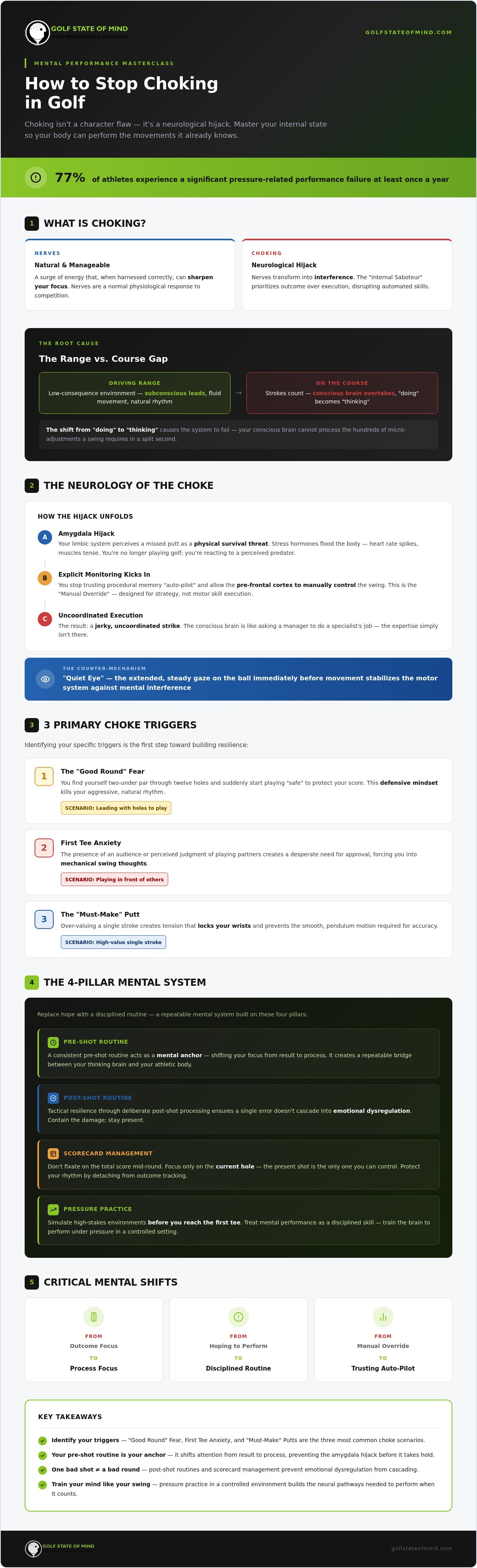
What Does Choking in Golf Actually Mean?
Golfers use the word “choking” very loosely.
They might say they choked because they missed a three-foot putt, hit a bad drive on the 18th hole or failed to convert a good round.
But one poor shot under pressure doesn’t necessarily mean you choked.
You’re going to hit bad shots sometimes, regardless of how mentally strong you are.
A more useful way to think about choking is that pressure changes the way you approach and execute something you normally know how to do.
Your attention changes.
Your decisions might change.
You become more aware of the consequences.
You might start consciously controlling your swing.
And the freedom you had earlier in the round begins to disappear.
Nerves and Choking Aren’t the Same Thing
This distinction is important.
Feeling nervous does not mean you’re choking.
Some of the best rounds of your life may include moments when your heart is beating faster, your hands feel different or you become very aware of how much the next shot matters.
That’s normal.
If you’re playing for something you care about, you’re probably going to feel something.
The problem begins when you interpret those feelings as evidence that something is wrong.
You notice your heart beating and think:
I need to calm down.
Then:
Why can’t I calm down?
Now part of your attention is on playing the golf shot and another part is trying to control your internal state.
You don’t need to feel completely calm to hit a good golf shot.
You need to be able to play while the nerves are there.
Why Do Golfers Choke Under Pressure?
Pressure is created by importance.
The more important an outcome becomes to you, the more likely your mind is to become attached to achieving it — or avoiding the opposite.
Think about a three-foot putt during a casual practice session.
Now imagine exactly the same putt to win your club championship.
The physical task hasn’t changed very much.
But the second putt means considerably more.
Now there are consequences attached to the result.
You might think about winning.
You might think about missing.
You might imagine what other people will think.
You might start thinking about your stroke.
You might desperately want to make sure you don’t pull it.
And that desire to guarantee the outcome can change the way you perform the task.
The Score You Don’t Have Yet
One of the most common pressure traps in golf is becoming attached to a score that doesn’t exist yet.
Imagine you’re three under par through 14 holes.
You start calculating:
Four pars and I shoot 69.
There’s nothing inherently wrong with knowing your score.
The problem is what can happen next.
Now you’re no longer simply playing the tee shot on 15.
You’re trying to protect 69.
But you haven’t shot 69.
There are still four holes to play.
Your mind has created a future outcome and then given you the job of protecting it.
That can lead to:
- more conservative or fearful decisions
- thinking about what could go wrong
- trying to steer the golf ball
- more technical swing thoughts
- checking the leaderboard or scorecard repeatedly
- thinking several holes ahead
- judging every shot by what it means for the final score
The irony is that the desire to protect the score can take you away from the process that created the score in the first place.
When You Stop Playing Golf and Start Protecting
Think about how you played the first 14 holes.
You probably weren’t trying to shoot 69 on every shot.
You were solving the problem in front of you.
What’s the lie?
What’s the wind doing?
Where’s my target?
What shot am I going to play?
Then you played it.
But once the score becomes important, the objective can subtly change.
Instead of:
Hit this drive at that target.
it becomes:
Don’t make bogey.
Instead of:
Roll this putt on this line at this speed.
it becomes:
I have to make this.
Instead of playing the shot, you’re playing its consequences.
That’s one of the most important shifts to recognize if you want to stop choking in golf.
Common Choking Situations in Golf
The situation is different for every golfer, but there are several scenarios where I see this pattern repeatedly.
Playing With a Lead
You’ve put yourself in a great position and suddenly feel as though you have something to lose.
You stop trying to create the next good shot and start trying not to make a mistake.
Approaching a Personal Best
You realize you’re on pace to break 80, 70 or your previous best score.
The number becomes increasingly prominent in your mind as you get closer to the clubhouse.
Trying to Qualify
You believe you need a certain score to make a team, qualify for an event or make a cut.
Every shot begins to feel as though it’s determining whether you achieve the goal.
The Final Few Holes
You become more aware of the finish line.
Instead of continuing to play the same way, you begin protecting your position.
A Must-Make Putt
The putt becomes about what making or missing means rather than simply reading the line, committing to the speed and rolling the ball.
The First Tee
Other people are watching. It’s a tournament. You desperately want to start well.
The desire to avoid embarrassment or make a good first impression can turn an ordinary tee shot into something that feels much bigger.
If that’s a specific challenge for you, read my guide to dealing with first-tee nerves.
Why Trying Harder Can Make Choking Worse
When the outcome becomes important, golfers often respond by trying harder.
But in golf, “trying harder” often means trying to control more.
You might start monitoring your backswing.
You become conscious of your takeaway.
You think about keeping the clubface square.
You try to guide the ball away from trouble.
You slow everything down because you want to make absolutely sure you’re ready.
You’re trying to remove uncertainty from the shot.
But golf doesn’t allow you to remove uncertainty.
You can make a great decision and a committed swing and still hit a poor shot.
Learning to perform under pressure requires becoming more comfortable with that reality.
You Don’t Need to Get Rid of the Thoughts
Another common mistake is believing that mentally strong golfers don’t have negative thoughts.
You’re three under with four holes remaining and your mind says:
Don’t blow this.
What now?
You could start arguing with yourself:
Stop being negative.
Stay positive.
Don’t think about the score.
But now you’re spending even more attention on the thought you’re trying to eliminate.
A more useful response is simply to recognize it.
There’s the score thought.
You don’t need to believe it.
You don’t need to fight it.
And you certainly don’t need to make it disappear before you’re allowed to hit the next shot.
You need somewhere useful to put your attention next.
Notice → Accept → Narrow
When you notice pressure beginning to change the way you’re playing, use this simple sequence:
1. Notice
Recognize what’s happening.
I’m starting to protect the score.
I’m thinking about the outcome.
I’m trying to make sure I don’t hit this left.
I’m getting more technical.
You can’t change a pattern you don’t recognize.
2. Accept
Don’t turn the pressure itself into another problem.
You might feel nervous.
Your heart might be beating faster.
You might desperately want the outcome.
That’s okay.
You’re allowed to care.
Accept that the situation matters to you without making calmness a requirement for playing well.
3. Narrow
Bring your attention back from the future to the task directly in front of you.
Not:
How do I shoot 69?
But:
What does this shot require?
Now you can return to your process.
Return to Your Shot Process
Under pressure, structure can be extremely useful.
I like to think about every golf shot in three phases:
Planning Phase → Athletic Phase → Acceptance Phase.
Planning Phase
This is where you think.
Assess the lie, wind, yardage, hazards and situation.
Choose your target.
Choose the shot.
See or feel what you’re trying to do.
Make a clear decision.
When you’re under pressure, be particularly aware of whether fear of the outcome is changing your strategy.
There’s a difference between making a smart conservative decision and choosing a shot purely because you’re afraid of making a mistake.
Athletic Phase
Once you’ve made the decision, it’s time to play.
This isn’t the time to solve your golf swing.
Connect with the target, intended ball flight, rhythm or feel that helps you play athletically.
Trust what you’ve trained.
Pressure may still be there.
That’s okay.
You don’t need the nerves to disappear before you swing.
Acceptance Phase
Once the ball has gone, your job changes again.
You can’t control where it finishes.
You can control how you respond.
Notice your reaction.
Accept the result.
Then begin preparing yourself for the next shot.
This becomes especially important under pressure because one mistake can easily become:
I’ve blown it.
Now you’re no longer responding to one poor shot. You’re reacting to what you believe that shot means for the entire round.
If you want to develop this process in more detail, read my complete guide to the mental pre-shot routine for golf.
Your Performance Commitments Matter More Under Pressure
One of the most useful things you can do before a competitive round is decide how you want to measure your mental performance.
I call these your Performance Commitments.
They’re behaviors you commit to regardless of the score.
For example:
- Choose a clear target before every shot.
- Make a committed decision before addressing the ball.
- Swing athletically rather than steering.
- Accept each result before moving on.
Why does this matter?
Because when pressure increases, your mind naturally wants to measure success by outcome.
Did I make the putt?
Did I make par?
Am I still three under?
Am I going to qualify?
Your Performance Commitments give you another scorecard.
One based on things you can actually control.
Instead of asking:
Can I hold onto this score?
your challenge becomes:
Can I continue executing my commitments while the pressure is here?
Don’t Judge Your Mental Game by the Result
This is critical.
You can execute your mental process beautifully and hit a bad shot.
You can also make a fearful, tentative swing and somehow finish ten feet from the hole.
The result doesn’t always tell you whether the process was good.
If you only reward yourself when the ball goes where you want it to go, you’ll become increasingly outcome-focused.
Instead, ask:
- Did I make a clear decision?
- Was I committed?
- Did I stay athletic?
- Did I accept the outcome?
That’s how you begin building a mental game that can hold up when the result matters more.
Want to Build a Stronger Mental Game?
I’ve put together a free mental game ebook to help you become a more confident, focused and resilient golfer.
How to Practice Playing Under Pressure
You can’t perfectly recreate tournament pressure on the driving range.
The consequences aren’t the same.
But you can make practice more demanding.
The purpose isn’t to make yourself anxious for the sake of it.
It’s to practice executing your process when there is something attached to the result.
Create Consequence
Instead of hitting 20 drivers toward the same fairway, create a challenge.
Perhaps you need to hit three out of five balls inside a defined fairway before moving on.
Or you need to hit the final ball successfully to complete the drill.
Notice what happens when you reach the ball that “matters.”
Do you change?
Do you become more careful?
Do you add a swing thought?
Do you take longer?
That’s useful information.
Practice Finishing
If you struggle when you’re playing well, simulate that situation.
Play three holes on the course and tell yourself you’re two under with three to play.
Or play a nine-hole practice round where your challenge is not the score but whether you execute your Performance Commitments on every shot.
The goal isn’t to convince yourself it’s really a tournament.
It’s to become familiar with noticing outcome thoughts and returning to the task.
Make Putting Practice Matter
Instead of endlessly hitting short putts with no consequence, create games.
Make 20 in a row.
Hole five different putts to complete the drill.
Or create a challenge where a miss means starting again.
Pay particular attention to the final putt.
That’s often where you’ll learn the most.
Does your stroke suddenly become more careful because you don’t want to start over?
If so, that’s exactly the response you’re trying to become more aware of.
What to Do After a Mistake Under Pressure
Suppose you’re three under through 14 and bogey the 15th.
Your mind might immediately say:
Here we go.
I’ve blown it.
I knew this would happen.
This is where the Acceptance Phase becomes especially important.
You don’t need to pretend the bogey doesn’t matter.
You may be disappointed.
Notice it.
But don’t turn one bogey into a prediction about the next three holes.
The score has changed.
Your job hasn’t.
Play the next shot.
If poor shots tend to trigger frustration or spirals in your game, my guide to emotional control in golf goes deeper into how to respond without carrying one shot into the next.
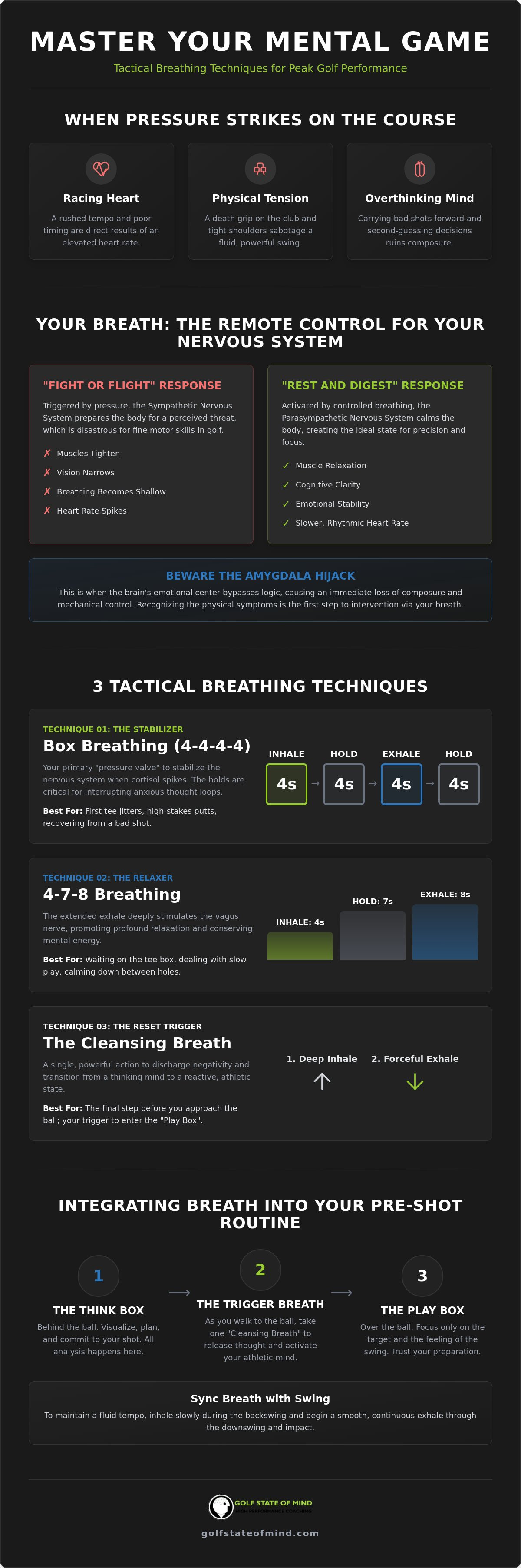
What About Breathing?
Breathing can be a useful tool under pressure.
A slower, intentional breath can give you a moment to pause and reconnect with the present.
But be careful about turning breathing into another test.
If your belief becomes:
I need to get my heart rate down before I can hit this shot…
you’ve created another condition that has to be satisfied before you’re allowed to perform.
Use breathing to help anchor your attention, not to demand that your body feels a particular way.
You can read more about breathing techniques for golf and how they can fit into your routine.
What If Choking Keeps Happening in the Same Situation?
If the same situation repeatedly changes the way you play, it may have developed into a more specific mental block.
Perhaps it’s always the same tee shot.
Perhaps it’s short putts.
Maybe you consistently struggle once you get under par.
Or perhaps it’s qualifying rounds.
At that point, it’s useful to examine not only what you do under pressure but what that particular situation has come to mean to you.
I’ve written a separate guide on mental blocks in golf that goes deeper into identifying those triggers and changing your response to them.
You Don’t Need to Ignore Your Score
There’s a common piece of mental-game advice that says:
Don’t think about your score.
I don’t think that’s always realistic.
If you’re playing a tournament, you may know exactly where you stand.
If you’re approaching your best round, you’re probably going to know it.
Trying desperately not to know or think about your score can become another mental battle.
The more useful skill is being able to know the score without allowing it to change your job.
You can know you’re three under.
You can know you’re leading.
You can know you need a good finish.
And then ask:
What does this shot require?
That’s the shift.
Pressure Isn’t Something You Need to Defeat
Golfers often talk about pressure as though it’s an opponent.
Something they need to conquer, eliminate or control.
But pressure usually exists because you’re doing something that matters to you.
You’re trying to win.
You’re trying to qualify.
You’re trying to shoot your best score.
You’re trying to achieve something you’ve worked hard for.
Of course you’re going to feel something.
The goal isn’t to make an important moment feel unimportant.
The goal is to become better at playing golf while it feels important.
How to Stop Choking in Golf: Remember These Three Words
When you notice yourself beginning to protect the outcome:
NOTICE → ACCEPT → NARROW.
Notice what’s happening.
Accept that nerves, excitement or outcome thoughts might be there.
Narrow your attention back to the shot in front of you.
Then return to:
Planning Phase → Athletic Phase → Acceptance Phase.
Make the decision.
Play the shot.
Accept what happens.
Then do it again.
How Do You Know You’re Getting Better Under Pressure?
Don’t only look at whether you shot the score or won the tournament.
Look at how you behaved when the pressure increased.
Did you notice yourself thinking ahead?
Did you recognize when you started protecting?
Were you able to return to your target?
Did you make committed swings?
Did you respond effectively when something went wrong?
Those are signs that your mental game is improving.
You might still feel nervous.
You might still think about the score.
You might still desperately want to win.
That’s not failure.
The goal is not necessarily to feel different under pressure.
It’s to become better at choosing what you do while the pressure is there.
Frequently Asked Questions
Why do I choke when I’m playing well?
Playing well can increase the perceived importance of the outcome. Once you realize you’re approaching a personal best, a win or another meaningful result, your attention can move from playing the next shot to protecting the score.
Notice that shift and bring your attention back to the immediate task rather than trying to guarantee the final outcome.
How do I stop thinking about my score?
You don’t necessarily need to.
It’s normal to know your score, particularly during competitive golf.
The more useful skill is noticing when thoughts about the final result begin changing your decisions, attention or swing.
You can know the score and still return your attention to what the next shot requires.
How do I calm my nerves in golf?
Don’t make complete calmness the goal.
Nerves are a normal response when an outcome matters to you. Breathing, routines and present-moment awareness can help you direct your attention, but you don’t need to eliminate the physical sensations of pressure before you can play well.
Why does my swing change under pressure?
One possibility is that you become more conscious and controlling when the result feels important.
You might add technical thoughts, try to guide the ball or become more careful with your movement.
A clear Planning Phase followed by an Athletic Phase can help you separate decision-making from execution.
What should I focus on when I’m under pressure?
Focus on the information relevant to the shot you’re actually playing.
Make a clear decision about the target and shot during your Planning Phase. Then connect with the target, intended ball flight, rhythm or another useful cue during the Athletic Phase.
Your Performance Commitments can also give you controllable behaviors to return to when your attention starts moving toward the result.
How can I practice golf under pressure?
Create practice games with consequences.
Rather than hitting endless balls, give yourself specific targets and challenges that require you to perform when a particular shot matters.
The goal isn’t to recreate tournament pressure perfectly. It’s to practice recognizing how your behavior changes when there is something attached to the result.
Is choking the same as the yips?
No. The terms describe different experiences, although anxiety and pressure can be involved in both.
Choking generally refers to underperforming when the stakes feel high. The yips can involve persistent difficulties with specific movements and may have different contributing factors.
If you’re experiencing involuntary movements or a persistent problem with putting, chipping or another specific action, it’s worth treating that as a separate issue rather than assuming it’s simply ordinary choking under pressure.
What should I do if I make a mistake when I’m close to a good score?
Be careful not to turn the mistake into a prediction.
A bogey doesn’t mean you’re about to collapse.
Notice your reaction, accept that the score has changed and return to the next task.
The score changed. Your job didn’t.
Take Your Mental Game Further
Playing well under pressure isn’t about becoming fearless.
It’s about developing skills that allow you to continue making good decisions, committing to shots and responding effectively even when the outcome matters deeply to you.
If you’d like to develop those skills further, I’ve put together a free mental game ebook to help you become a more confident, focused and resilient golfer.
Click here to get your free mental game ebook
Get your FREE Mental Game Scorecard

Mastering Golf Breathing Techniques: The Mental Anchor for Peak Performance
Imagine standing on the eighteenth tee with a career-best round within reach, only to feel your grip tighten and your heart hammer against your ribs….
Get your FREE Mental Game Scorecard
Competitive Golf Mental Preparation: The Elite Guide to Tournament Success
Why does the swing that felt effortless on the practice range suddenly feel like a foreign object the moment you step into the tee box? Many players…
Get your FREE Mental Game Scorecard